
The Magic 8-Ball Problem: Why Banks Don't Trust AI (And How to Fix It)
Let’s get real for a second. Banks aren't dragging their feet on AI ...
The real problem is that commercial lending is ridiculously complicated. It’s like running a restaurant with a 50-page menu but only two chefs in the kitchen. Eventually, you stop offering the fancy dishes, not because you don't want to sell them, but because you just don't have the staff or the time to cook them.
Everyone says, "AI is the solution!" But here is the massive elephant in the room that tech companies don't want to talk about: AI is unpredictable. AI is actually more complex and harder to implement that promised. A
If you ask a standard Artificial Intelligence model a question on Monday, and then ask it the exact same question on Tuesday, you might get two completely different answers. That’s totally fine if you’re asking it to write a funny poem about a cat. It is absolutely terrifying if you are asking it to evaluate a $5 million commercial loan.
Imagine a bank auditor knocking on your door to ask why a specific deal was structured the way it was. If your answer is, "I don't know, the computer just felt like it today," you'd be fired before lunch. Banks cannot run on guesses or probabilities. They need cold, hard certainty.
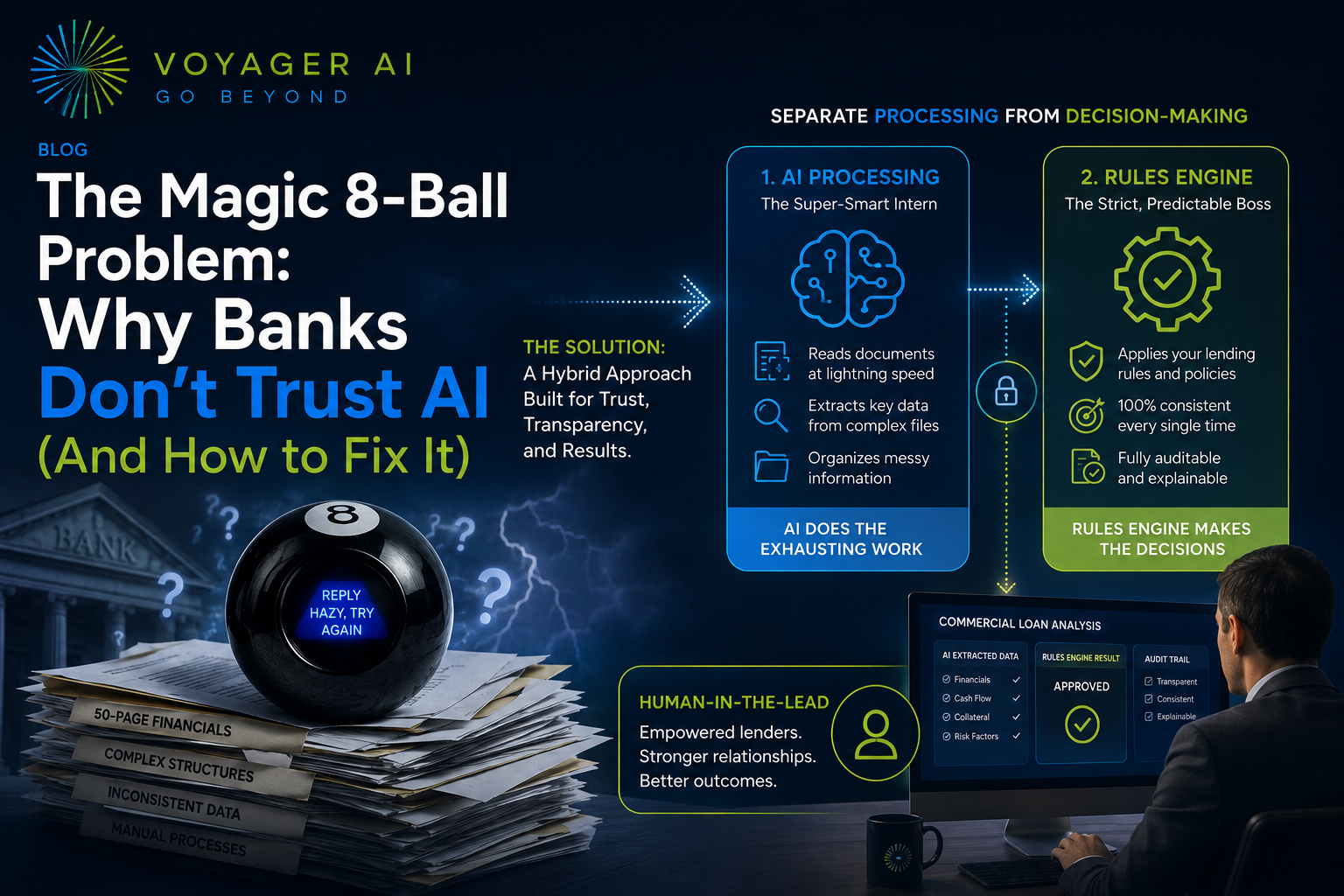
So, how do we make AI safe for a bank to actually use? We create a hard architectural separation between processing data and making decisions.
Think of AI like a super-smart, caffeinated intern. This intern is amazing at doing the exhausting busywork. They can speed-read messy tax returns, dig through 50-page PDFs, and instantly pull out the key numbers you need. But, and this is the important part, you do not let the intern make the final call on the deal.
To make a system reliable, the actual decision-making part (the rules engine) cannot be run by an AI brain. You can't audit the missing person.
Instead, once the AI intern gathers the data, it hands those numbers over to a strict, perfectly predictable calculator. This is where we write the actual math and logic. There is no guessing. There is no "AI magic." If you feed the exact same financials and risk profiles into this strict rules engine one thousand times, it will spit out the exact same answer one thousand times.
This hybrid approach changes everything. You use AI to do the exhausting work of organizing messy data, but you use strict, hard-coded logic to actually execute your lending rules.
Ultimately, this isn't just about maximizing efficiency. It’s about putting the customer first. The whole point of computers is to handle the tedious stuff so people can be better people with each other. When the system handles the heavy lifting safely and predictably, your team can get back to providing incredible service and building real relationships.
But if the AI is the intern and the rules engine is the boss, where does that leave the actual human lender? Most tech companies talk about putting a "human-in-the-loop"—which is really just a polite way of saying they want you to be a glorified babysitter for a robot. We think you should be a "human-in-the-lead" instead. (We’ll break down exactly what that means, and why babysitting algorithms is a waste of your talent, in our next post).
#AI #Banking #CommercialLending #Fintech #FinancialServices #Lending